
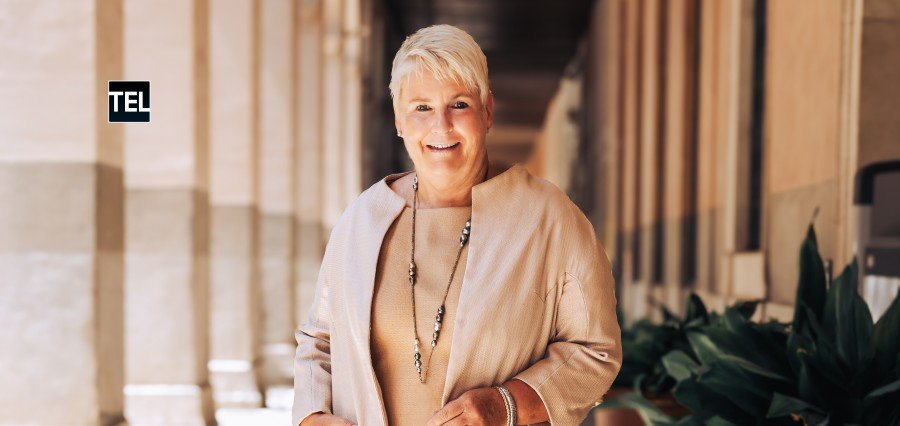
Martina Becker-Zahn has known the world of SME entrepreneurs since she was a child. She grew up in a family home with a long-established family business and experienced first-hand how intense the pressure can be to know everything, decide everything and do everything right. Not to mention the burden of tradition and the constant balancing act of meeting the family’s expectations.
Today, through her company Martina Becker Mentoring Business Coaching, she offers support to precisely these entrepreneurs – and challenges an outdated image of leadership: the boss who carries everything alone and ultimately makes decisions in isolation. Instead, she encourages a new understanding of leadership – one in which employees contribute their ideas, share responsibility and help shape the business. And in which entrepreneurs are allowed to show themselves as they really are: not infallible, but human.
What drives her is greater than the win-win situation for the individual company. Martina Becker-Zahn is convinced that when entrepreneurs involve their employees in decisions, not only are better results achieved, but also greater satisfaction. And that is exactly what our society urgently needs right now: less frustration, less exhaustion, more meaning and appreciation for oneself. Entrepreneurs have the power to change things. And they should use it.
In this conversation, Martina Becker-Zahn talks about what has shaped her, how effective modern leadership is – and why it is so important for real change in our society.
-
How would you describe your professional career leading up to the founding of Martina Becker Mentoring?
After studying economics, I worked as a buyer in various industries and companies of different sizes. But regardless of whether it was a large corporation or an owner-managed family business, they all had one thing in common: employees were expected to do their jobs – nothing more! Questions about what could be improved or what would be necessary to exceed profit or sales targets were discussed behind closed doors by the management team. As an employee, you were not asked for your opinion or even your ideas.
I come from a family of medium-sized entrepreneurs, and part of my upbringing was to think outside the box, think entrepreneurially and make quick decisions. After 15 years as an employee, I decided to start my own business because I was more than just a cog in the wheel, and in doing so, I also realised my childhood dream of living by the sea.
From purchasing to self-employment
In Mallorca, I used my purchasing skills to expand into global imports and opened a furniture store. Over the years, developed into a business modernising and furnishing apartments, and I eventually became a self-employed estate agent with my own office and international clients. I also worked as a property developer. I was successful in my career. But something was missing.
At that time, I attended a classic negotiation seminar and suddenly found myself in a seminar on NLP. The trigger was the word “beliefs” and what I learned about them was invaluable for myself, but also for dealing with high-profile clients.
I enjoy learning and when something interests me, I like to delve deeper into it. So, alongside my professional activities, I continued my training as an NLP Master and also completed a combined Life & Business Coaching training course at the Coaching Academy Frankfurt. As my understanding of business coaching always includes the person with their personality – and not just the manager in their professional role – this dual training approach was an advantage for me.
2020 was then the year of change. On the one hand, my father asked me to support him in his company in Germany. That was a matter of course for me. Then came Corona, and even in Mallorca, nothing worked anymore. And on top of that came the realisation that “selling” no longer fulfilled me. I wanted to work with people.
Coaching for small and medium-sized enterprises
The decision to work as a coach was not a difficult one for me. But this career change did not happen quickly, because switching to an online business at the age of 53 was not easy for me. Outsiders don’t see how much expertise you have to acquire, from many new technologies to self-marketing on social media. The latter was not easy for me, so I first gained entrepreneurs from the Mallorca region as clients and founded Martina Becker Mentoring.
Although I coach in Spanish, English and German, I am currently focusing on medium-sized entrepreneurs in Germany. On the one hand, because it is incredibly important for German society right now that people find joy, meaning and satisfaction in their work again. On the other hand, I know that medium-sized entrepreneurs in particular often feel too small for the tools/methods/innovations that large companies have already established. Coaching still encounters a lot of criticism and scepticism in Germany. I want to help change this so that coaches are seen as personal trainers who offer individual support in achieving one’s own goals.
-
What made you decide to focus specifically on supporting medium-sized companies?
Because this target group in particular – often male, between 40 and 65 years old, mostly from traditional industries – faces major challenges in terms of leadership and teamwork and is also a very success-oriented generation. They know that their companies can only survive in the future if they introduce better processes, a functioning team structure and modern leadership, because the old leadership models no longer work for them. Now they find themselves in a mental dilemma: as “bosses,” they have to learn new things and admit their own weaknesses, while their self-image as leaders demands that they know everything.
I have known this type of entrepreneur since my childhood. I know how much energy it takes to maintain this façade of being a strong, all-knowing entrepreneur in front of employees, business partners and even one’s own family. Accompanying change here
+ that entrepreneurship can be so much easier when employees can also contribute ideas
+ that a boss who is committed to lifelong learning and is not always omniscient becomes so much more human and accessible
and creates a whole new sense of cohesion among the workforce is so much more than just a job to me. To many, this may not sound appropriate in this context, but it simply warms my heart. As the daughter of an entrepreneur, I know first-hand that entrepreneurship can also be a heavy burden, especially in family businesses. There is still room for more lightness.
-
How do you help entrepreneurs detach themselves from day-to-day business?
The standard answer I so often read to this question is: “By teaching them clear structures for delegation and employee co-responsibility”. In my experience, however, there is a completely different obstacle to overcome first: Many of my clients are stuck in a state that can aptly be described as “mindfuck” (mental self-sabotage): they work to their limits, distrust the competence of their employees, want to maintain control – and slowly burn out in the process. They don’t even realise that they are placing absurd expectations on themselves and making life difficult for themselves.
Only when a new perspective is achieved is the way clear to free oneself from the operational “I do everything myself” mode and allow oneself to build a team that can take responsibility and develop an entrepreneurial mindset. It is very much about relinquishing control. Entrepreneurs tend to keep as much as possible in their own hands – even if it leads to absolute exhaustion.
But here, too, I have had insights into this way of thinking since my childhood, so it is very familiar to me. I help to recognise these patterns. And then: to break them. This cannot be done with checklists. Rather, it requires genuine self-reflection. And practical tools that work directly in everyday life.
-
What are your clients’ biggest challenges in terms of employee retention and sustainable leadership?
- Skills shortage: retaining good employees and attracting new ones
- Lack of employee retention: Until now, technology has been the driver of innovation. There is often still a lack of awareness that it is now the quality of employees that gives companies a competitive advantage in terms of innovative ideas, processes and products.
- Uncertainty in leadership: especially when it comes to conflicts of values with the younger generation
- Lack of feedback and team culture, no transparent communication: old management habits often prevent employees from giving their best
-
What strategies are most effective in promoting a culture in which employees want to stay?
- Appreciation and feedback culture: employees want to be “seen”, not only for their performance, but as human beings.
- Promote entrepreneurial thinking: make employees co-creators and communicate to them their important contribution to the company’s goals.
- Modern management tools: regular employee appraisals, individual potential development and transparent communication enable creative freedom and promote inner satisfaction.
- Clear roles and responsibilities: A sense of security arises when employees know exactly what they are responsible for.
-
What core values guide you in your work?
My most important values are freedom/independence, honesty and fairness. I am also pragmatic and someone who rolls up their sleeves and gets things done. I am interested in results – and they have to come quickly, as I am impatient by nature – just like my clients. I also live by these principles as a coach.
Firstly, I only work with entrepreneurs who are willing to work on themselves before demanding change from others. A personality test at the beginning of the collaboration shows the extent to which I “fit” with the client and am the right coach for them, because it takes a certain degree of familiarity to feel comfortable sharing very personal thoughts and emotions during coaching. However, if the collaboration does not meet the client’s expectations, they can terminate it at any time with 14 days’ notice. So far, no client has made use of this option, but it creates a basis of trust and transparency.
I am a sparring partner who works on an equal footing, is practice-oriented and avoids theoretical “consultant clichés”. My approach is practical, solution-oriented and aimed at restoring the entrepreneur’s confidence, self-efficacy and sense of purpose in their role. My role can vary flexibly depending on the coaching assignment; depending on the situation, I am a coach, consultant or even a confidant, providing individual support to my clients.
-
How do you stay up to date in coaching?
I find it difficult to define what it means to be “up to date” in coaching. Extensive methodological knowledge and continuous training are certainly important components. But you also need an extremely deep understanding of your target group. I need to know my clients’ world well and understand how they think, what their concerns, desires and fears are. And then a good dose of intuition is an advantage, because coaching sessions cannot be planned in detail. Unforeseen problems and deep emotions can arise. That’s where my gut feeling comes into play, which is very good at deciding what is the best support for the client at that moment.
A mixture of professional development seminars, an extensive and constantly growing collection of specialist books on topics such as coaching, leadership, personal development and psychology, and, last but not least, training my intuition are the basis for me to be able to do good and very individual work as a coach at all times.
-
Have there been any milestones, awards or successes that confirm your work?
My work has less to do with awards, and my clients’ successes are rarely published in full, as they involve very personal insights and changes. I also do not strive for quantitative milestones, as very individual 1:1 support is very important to me. That is why the success of my clients is my greatest confirmation: entrepreneurs who, through my work, have managed to get off the operational treadmill, build a stable team and rediscover joy and meaning in their role. However, I value my membership in the ICF (International Coaching Federation) because the professional title “coach” is unfortunately not protected and the obligations of ICF membership contribute to the quality of coaching.
-
How do you personally manage the balance between work and well-being?
I am one step ahead of my clients and had to learn for myself what I teach my clients: self-care is not a luxury, but a prerequisite for performance. This includes clear boundaries between work and private life, conscious breaks from mobile phones and computers, and activities that regenerate me mentally and physically.
Here’s a little anecdote: I showed up for a second online coaching session with a client dressed in business attire, but with my hair still wet. I had been swimming during my lunch break – a no-go for him! Now he uses his lunch break for exercise and understands that he just has to give himself permission to do something for his health and that he is only accountable to himself.
-
What are your future goals for Martina Becker Mentoring?
I want to help ensure that owners of small and medium-sized businesses in particular see themselves not only as employers, but also as creators of a working environment that empowers people. And thus society as a whole.
Because it’s about more than just good leadership. An entire generation – today’s managers – has experienced work primarily as the daily completion of tasks: little creative freedom, no co-determination, hardly any visibility. Many were never really able to show their talents. Their children, in turn, saw their parents come home from work tired, frustrated or ill – and today associate work more with overload than fulfilment.
Work must be able to inspire enthusiasm again. Today, it is precisely the many small and medium-sized entrepreneurs who are setting the course not only for their companies, but also for society as a whole. I find it very fulfilling to help entrepreneurs become multipliers of motivation, solidarity and trust.
Because those who are allowed to have a say and are listened to not only feel responsible – they also feel connected. And that is precisely what makes the difference: in business, as in our society.
🔹 Variation
Participation creates responsibility. And those who take on responsibility lose faith in simple slogans. That is why modern leadership is not just a business issue – it is a democratic task.