
Prime Highlights
- Kazakhstan signed 30 commercial agreements worth around €10 billion with European partners.
- New EU agreements will boost air connectivity and simplify travel procedures for Kazakh citizens.
Key Facts
- The EU is Kazakhstan’s largest trade and investment partner, with annual trade exceeding $45 billion.
- Cargo volumes along the Middle Corridor have increased fivefold over the past six years, reaching 4.1 million tonnes.
Background
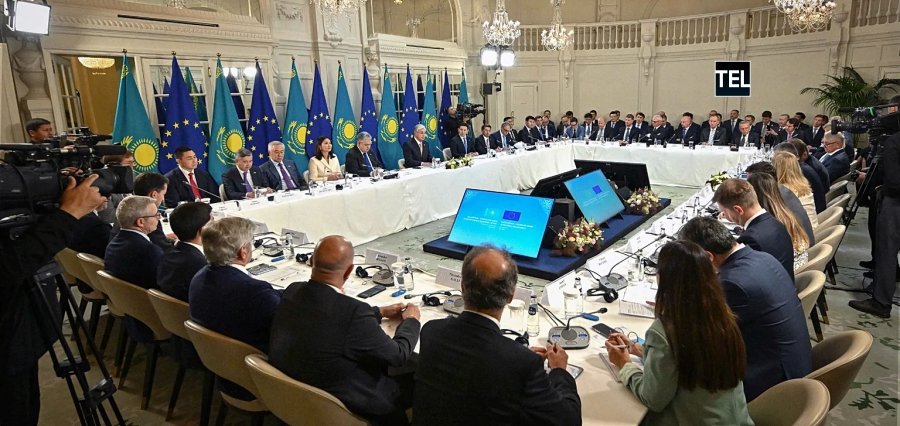
Kazakhstan wrapped up President Kassym-Jomart Tokayev’s visit to Brussels with 30 commercial agreements worth around €10 billion, signed between Kazakh and European businesses at a high-profile bilateral forum.
The deals spanned energy, aviation, logistics and industrial sectors. The largest single transaction was a €7.3 billion certification agreement between Air Astana and Airbus, covering the purchase of 50 aircraft from the A320 family.
Deliveries are scheduled to begin in 2031. Kazakhstan’s sovereign wealth fund Samruk Kazyna accounted for €8.4 billion of the total deal value signed during the visit.
A separate €967 million contract went to French locomotive manufacturer Alstom, covering maintenance services for locomotives it already supplies to Kazakhstan Railways, with the deal aimed at improving traffic reliability along the Middle Corridor trade route.
Tokayev told the forum that the European Union accounts for nearly half of all foreign direct investment flowing into Kazakhstan, with bilateral trade topping $45 billion last year.
He said close to 4,000 European companies already operate in the country and that Kazakhstan is ready to supply Europe with 21 of the 34 strategically important rare earth materials it needs.
Five agreements were also signed with the European Commission, including a Horizontal Aviation Agreement that opens routes between Kazakhstan and 17 EU member states that currently lack bilateral air service deals.
A separate accord eases visa conditions for Kazakh nationals travelling to Europe, cutting costs and reducing processing times.
The visit built on commitments made at the EU-Central Asia summit in Samarkand in April 2025, where European Commission President Ursula von der Leyen announced a €12 billion investment package for the region.